
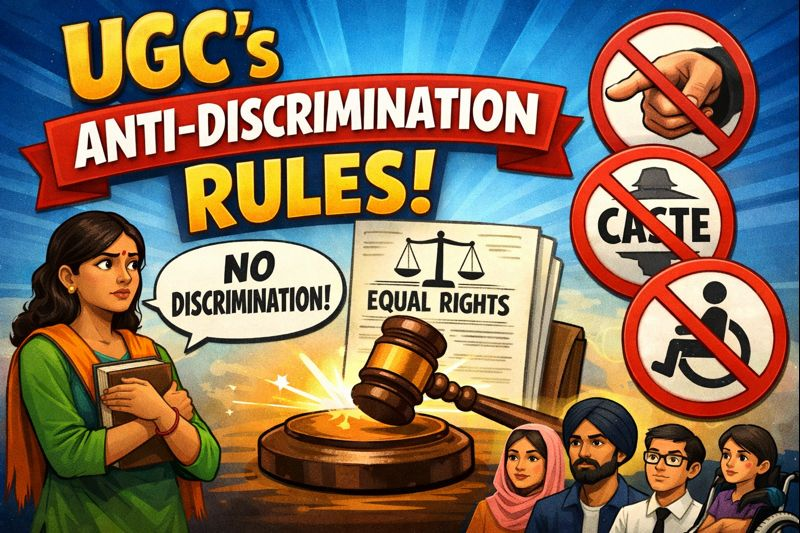
New Delhi, February 1, 2026 – The University Grants Commission (UGC) introduced the Promotion of Equity in Higher Education Institutions Regulations, 2026, in January, aiming to combat caste-based discrimination in India’s higher education sector. These rules build on the 2012 framework but expand protections and enforcement mechanisms amid rising complaints and Supreme Court directives. However, the regulations have sparked protests, legal challenges, and debates over their scope and potential biases. Just days after notification, the Supreme Court stayed the rules on January 29, citing their “too sweeping” nature and risks of societal division. This article examines what has changed, what experts see as improvements, and the ongoing concerns.
What Has Changed: From 2012 Advisory Guidelines to 2026 Mandatory Framework
The 2012 UGC regulations, formally known as the UGC (Promotion of Equity in Higher Educational Institutions) Regulations, were introduced following high-profile incidents like the 2011 suicide of an AIIMS student and the 2016 protests over Rohith Vemula’s death at the University of Hyderabad. These rules mandated Equal Opportunity Cells (EOCs) in institutions to address discrimination primarily against Scheduled Castes (SC) and Scheduled Tribes (ST) students, drawing from laws like the Protection of Civil Rights Act and the Scheduled Castes and Scheduled Tribes (Prevention of Atrocities) Act. They listed 28 specific forms of discrimination but were largely advisory, lacking robust enforcement, clear grievance timelines, or protections against victimization. Coverage was limited, focusing on SC/ST welfare without explicit inclusion of Other Backward Classes (OBCs) or employees.
The 2026 regulations represent a significant overhaul, responding to a Supreme Court order in September 2025 and a 118.4% surge in discrimination complaints from 173 in 2019–20 to 378 in 2023–24 across over 700 universities and 1,500 colleges. Key changes include:
- Expanded Scope: Protections now explicitly cover OBCs—for the first time—alongside SC, ST, gender minorities, persons with disabilities, faculty, and non-teaching staff. This addresses the demographic reality where OBC students number 1.63 crore, SC 66.23 lakh, and ST 27.1 lakh as per 2021–22 All India Survey on Higher Education (AISHE) data. Coverage extends to online and distance learners, shifting from a caste-specific focus to a broader “equity” model encompassing caste, gender, disability, and religion.
- Institutional Structures: The single Anti-Discrimination Officer and EOC from 2012 are replaced by a multi-layered system, including an Equal Opportunity Centre (EOC) for disadvantaged groups, a multi-member Equity Committee chaired by the institution’s head (with mandatory representation from OBCs, SCs, STs, women, and persons with disabilities), Equity Squads to monitor vulnerable areas, Equity Ambassadors in departments and hostels, a 24/7 helpline, and an online complaint portal. Institutions must submit bi-annual public reports and annual updates to UGC.
- Enforcement and Penalties: Grievance handling is now time-bound—the Equity Committee must convene within 24 hours, submit reports in 15 working days, and institutions act within seven days, with appeals to an Ombudsperson. Non-compliance can result in withdrawal of UGC funding, degree-granting powers, or institutional recognition. The 2026 rules delete a 2012 clause on penalties for false complaints, emphasizing victim protection.
These updates align with the National Education Policy 2020’s emphasis on inclusion and address past implementation gaps, such as half of institutions ignoring the 2012 rules per 2018–2019 RTI data.
What Has Improved: Stronger Accountability and Broader Inclusivity
Experts acknowledge several advancements in the 2026 framework. Prof. O.R.S. Rao, a higher education analyst, praised the rules for clarifying institutional responsibility: “The draft had attempted to clear confusion over institutional responsibility by holding heads of institutions accountable.” The inclusion of OBCs and employees fills a critical gap, given that SC, ST, and OBC students comprise 60.8% of higher education enrollment. Enhanced monitoring through squads, ambassadors, and digital tools improves accessibility and response times, moving beyond the 2012’s vague 60-day inquiry deadline.
Sociologist Satish Deshpande views the regulations as a “symbolic advancement,” making caste discrimination “undeniable and harder to ignore,” potentially fostering long-term resistance against oppression. The mandatory reporting and penalties shift from advisory compliance to enforceable governance, addressing historical failures in cases like the 2019 suicide of Payal Tadvi, where families were unaware of existing mechanisms. Overall, the rules promote a more inclusive campus environment, integrating with broader equity goals.
What Still Concerns Experts: Dilutions, Biases, and Implementation Gaps
Despite progress, experts raise alarms over dilutions and risks. Prof. N. Sukumar criticized the removal of “caste” from the title and the shift to an illustrative list of discrimination forms, arguing it erodes specificity: “Several critical elements of the 2012 framework… have been diluted or entirely omitted.” Prof. Sukhadeo Thorat pointed to structural issues, such as unclear institutional coverage (excluding bodies like ICMR or ICAR) and the head chairing the Equity Committee, which could compromise impartiality: “The head should not be the chairman.”
Critics from outlets like OpIndia highlight “explicit bias against general castes,” as the rules frame discrimination solely against SC/ST/OBC, excluding upper castes and lacking safeguards for false complaints. This echoes judicial concerns, such as Madhya Pradesh High Court Judge Vivek Agarwal’s 2025 remarks on SC/ST Act misuse and the need for honest investigations to protect innocents. The absence of penalties for malicious allegations—deliberately omitted to avoid deterring victims—raises fears of extortion or vendettas, with no independent verification or external oversight.
Advocate Disha Wadekar noted enforcement flaws: “This shifts interpretive power to internal committees without clear standards, inviting inconsistency, arbitrariness, and selective enforcement.” Academics like Latika Gupta argue the rules focus on behavioral fixes, ignoring systemic issues like schooling disparities and institutional apathy toward scholarships. Grouping caste with other categories dilutes its unique social stigma, and reliance on internal bodies risks bias or ineffectiveness, as seen with past anti-ragging cells.
Protests have erupted, including from upper-caste groups and Ekdandi sadhus in Prayagraj on January 28, claiming the rules create a “hierarchy of victimhood.” The Supreme Court’s stay emphasized inclusivity, questioning if the rules regress toward a casteless society by excluding general categories and potentially escalating minor disputes.
Looking Ahead
With the 2012 rules reinstated pending further hearings on March 19, the 2026 regulations highlight India’s ongoing struggle with caste equity in education. Experts like Furqan Qamar stress building trust and leadership quality for effective implementation, while suggesting curricular reforms and social audits. As debates continue, the rules underscore the need for balanced protections that address historical injustices without fostering new divisions.