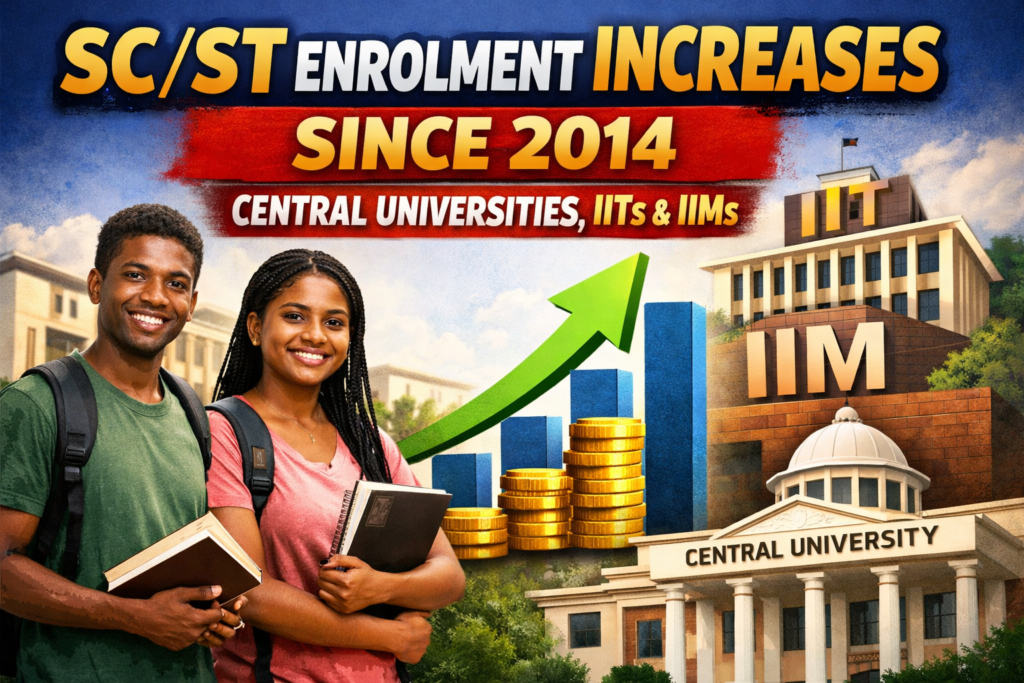
The enrolment of Scheduled Caste (SC) and Scheduled Tribe (ST) students in India’s premier central higher education institutions has shown consistent growth since 2014, reflecting expanded access through reservation policies, institutional expansion, and targeted inclusion measures.
According to recent data presented by the Union Ministry of Education in Parliament, enrolment figures for SC and ST students rose notably across Central Universities, Indian Institutes of Technology (IITs), and Indian Institutes of Management (IIMs) between the academic years 2014-15 and 2022-23 (provisional).
In Central Universities, SC student enrolment increased from 71,621 in 2014-15 to 89,182 in 2022-23, marking a rise of approximately 24.5%. ST enrolment grew from 25,964 to 32,801 over the same period, an increase of about 26.3%.
The IITs recorded a more pronounced uptick, with SC enrolment climbing from 10,392 to 18,076 (a growth of around 74%) and ST enrolment rising from 4,546 to 7,408 (an increase of roughly 63%).
Similarly, in the IIMs, SC student numbers rose from 983 to 2,537 (an increase of over 158%), while ST enrolment increased from 410 to 942 (a growth of about 130%).
This upward trend aligns with broader national patterns in higher education. The All India Survey on Higher Education (AISHE) reports indicate that overall SC enrolment in higher education grew by 44% from 46.07 lakh in 2014-15 to 66.23 lakh in 2021-22, with female SC enrolment rising by 51%. ST enrolment saw a substantial 65.2% increase nationally during the same timeframe, reaching 27.1 lakh, including an 80% rise in female ST enrolment.
The government has attributed these gains to several factors, including the expansion of institutions (e.g., Central Universities increasing from 40 to 48, IITs from 16 to 23, and IIMs from 13 to 21 since 2014), implementation of reservation quotas, establishment of functional SC/ST cells in all relevant institutions, and initiatives like supernumerary seats to boost participation from underrepresented groups.
These developments underscore ongoing efforts to promote equity and inclusivity in elite technical and management education, though challenges such as retention, faculty diversity, and addressing dropout rates in reserved categories remain areas of focus in policy discussions.